
|
Piazza
dei Cavalieri (Square of the Knights)
This
square, known in the time of the Pisan Republic as the Square of the Seven Roads,
is thought to be the site of the Forum of Roman Pisa. It was the centre of
politics of the Pisan Republic when it was transformed by Cosimo I de Medici
into the seat of the new military order of «The Knights of Saint Stephan with
the aim of eradicating any trace of the city's past independence. Its present
appearance is therefore the fruit of radical renovations of the surrounding
palaces, for the most part designed by the Florentine architect Giorgio Vasari
in 1562. In the square's centre can be seen a fountain beneath the statue of
Cosimo I in the robes of Grand Master of the Order of Knights, both the work of
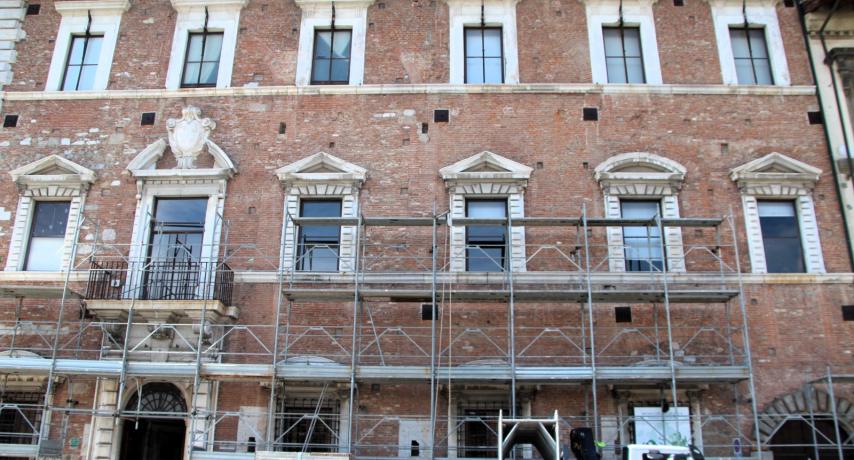
Pietro Francavilla in 1596. Behind the statue rises the Palazzo della
Carovana dei Cavalieri. This,
the old republic's Hall of City Elders was entirely transformed by Giorgio
Vasari with its present facade which recall, both in style and subject, various
buildings along Via dei Mille and Via Ulisse Dini. The building now houses the
Scuola Normale Superiore, the elite University founded by Napoleon Bonaparte who
modelled it after the Ecole Normale Superieure in Paris. Within its walls have
studied many of Italy's most famous personages, such as the poet, Giosuč
Carducci and the physicist Enrico Fermi. Opposite and to the left of the Scuola
Normale stands the Palazzo dell'Orologio which was transformed into its present
structure for the infirmary of the Knights by uniting by bridge the two
crumbling towers of the Count della Gherardeschi. In Canto XXXIII of his
Inferno, Dante Aleghieri recounts the story of the fate of the suspected traitor,
Count Ugolini. Tradition holds that it was in one of these towers that, in 1288,
he was left to die of starvation, along with the other males of his family whose
corpses he fed upon.
Beyond
Via Corsica, after the Oratorio di San Rocco, you will find the former Collegio
Puteaneo, founded in 1605 by the Archbishop, Antonio Dal Pozzo to lodge the
students of the city of Biella attending the University. Its facade is adorned
by the original frescoes of Stefano Marucelli, as is the Palazzo dell'Orologio.
On the southern side of the square stand the monumental Palazzo del Consiglio
dei Dodici (Palace of the Council of Twelve), the ancient site of the city
magistrature which was completely refurbished in 1596 according to a project by
Pietro Francovilla. Later the building became the Court of the Knights of Saint
Stephan. In its interior can be seen a hall with walls frescoed in architectural
motifs and ceiling engraved and painted by Ventura Salimbeni of Siena. To the
right of the Scuola Normale, the Church of Santo Stefano dei Cavalieri (10)
completes the tour of the square. Its construction, begun in 1565 following the
plan of Giorgio Vasari, was completed in 1593 with the addition of the facade
designed in rich architectural motifs by Don Giovanni de Medici. Its hall-like
interior is closed overhead by a richly engraved and gilded wooden ceiling
including paintings of the greatests artists of the de Medici era. Particularly
interesting are the banner-trophies and various parts of ships seized from the
Turks by the Knights during their policing operations in the Tirreno Sea in
order to guarantee safe passage there. Beside the sacristy is a collection of
costumes and memorabilia commemorating the activities of the Knights. |